Introducing Network Features Can Help Your Organization Detect Risks at Speed
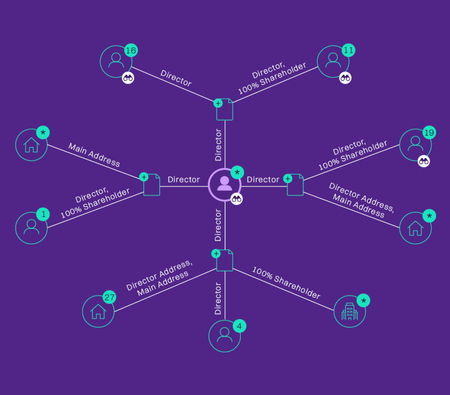
The importance of context In the world of risk modelling, the input data points (or features) are particularly important – usually even more important than the choice of model or algorithm. In an industry with significant regulatory pressure for transparency and explainability in modelling, model choice is often restricted meaning the choice of input features can be the core reason for success (or failure) of the model. So, the key question is – how can we bring as much context into our features as possible? Network-based features provide an excellent way to inject a huge amount of information into your model, whilst keeping the required transparency and explainability. One way of achieving this is by using bespoke document-entity networks to generate features describing how businesses and individuals are related to each other. At Quantexa, we’ve used network features describing relationships between companies and their directors as key inputs into our Shell Company detection model, which has resulted in a 20% uplift in performance compared to using just record-level features. The model output – predicted shell companies and the incorporating agents creating them – has a range of applications for enhanced risk detection across AML (Anti-Money-Laundering), KYC (Know-Your-Customer), Risk and Fraud. Introducing network features Networks can be used to model relationships between entities in many different circumstances. For example, networks of payments between parties can be used to find signs of financial crime. Searching for certain shapes in the network (e.g. cycles of similar sized payments) can lead to the detection of risks that would not have been identifiable by looking at transactions in isolation. Simple characteristics such as the size of a network, the number (or density) of connections, and the number of layers can all be useful dimensions for segmentation or feature generation. The power of networks in machine learning In the Quantexa Shell Company detection model, we have used a combination of features derived from organizations’ wider networks (including their legal hierarchies and director networks) and from company registry records. These network features include the identification of network shapes and patterns, as well as using techniques from graph analytics (including centrality analysis) to create new information about the entities in the network, like finding directors with high importance in the network. The director in the network has control of four organizations, all with single shareholders and based in profligate (or highly connected) addresses. Creating features such as ‘director’s company is based at a profligate address’ and ‘director shares directorship with a 100% shareholder’ can be very informative in finding shell companies. In addition, the director above has high ‘page rank’ (centrality) in the wider network. These new network characteristics are used as features within a company-level model. This evaluates if each company is likely to be a shell based not just on its own characteristics (size etc.) but also on this network context. Including network features in the model significantly enhanced its performance and has so far led to the identification of over ten thousand new shell companies not identifiable from record-level models alone. The use of network features to provide context has added significant value in other areas too, including scorecard tuning, and even data quality analysis.27Views0likes0Comments