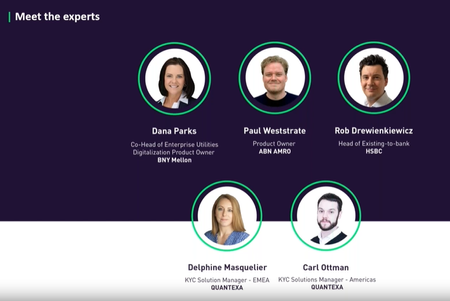
ContributionsMost RecentMost LikesSolutionsTagged:TagNew blog on various journeys to KYC transformation - tell us how you are approaching it! While there is no "one-size-fits-all" journey to pKYC, the same foundations are critical to success for banks. Discover our latest blog on 'Pathways to pKYC: Different Journeys, Same Foundations' and let us know how you are intending to take on this transformation. https://www.quantexa.com/blog/pathways-to-pkyc/ Upcoming Webinar on Unlocking the Power of pKYC: Dec 5th & 7th (EMEA & APAC) Join Quantexa’s Delphine Masquelier, Thomas McNally and Carl Ottman for two webinars that demystify the pKYC transformation journey. We'll share insights gained from real-world pKYC deployments, representing some of the earliest implementations. Register here: https://community.quantexa.com/events/115-unlocking-the-power-of-pkyc-smarter-kyc-processes-emea https://community.quantexa.com/events/114-unlocking-the-power-of-pkyc-smarter-kyc-processes-apac Work your way through an Enhanced Due Diligence use case in Quantexa's AML Investigator course Just like AML investigators, analysts specialised in Enhanced Due Diligence (EDD) cases are required to master the art of detecting the risk within a customer's profile or activity. This program teaches individuals how to combine many of the key components of the Quantexa platform that they have learnt about in the Quantexa Foundations program in such a way as to facilitate their ability to conduct an EDD themed Investigation. (Duration: 4 days) Having completed the program, learners will understand the relevant core concepts and how to use the key UI components of the Quantexa platform based on a Know Your Customer (KYC) use case. Modules include: Quantexa User Foundations Program - Introduces the core concepts of our platform, including Networks, Documents, Entities, and Entity Resolution. This Program also introduces Search, Investigation and Task components of the Quantexa platform’s UI. Quantexa Investigations Series: AML Investigator - Teaches how to combine many of the key components of the Quantexa platform that you have learnt about in the Quantexa Foundations program in such a way as to facilitate your ability to conduct an AML or EDD themed Investigation. Outcome: On successful completion of the program and its associated Knowledge Check, learners will be awarded the Quantexa Investigations Series: AML Investigator completion badge. Read more about the courses we offer and how to sign up in our Introduction to Quantexa Education Services and the Quantexa Academy For more Financial Crime updates, discussions, and events why not join our Financial Crime User Group? Listen to ABN AMRO, BNY and HSBC talk all things KYC and transformation As the pKYC transformation topic is still top of mind for most FIs, we have asked three banks to talk to us about their journey and how they are approaching the future of due diligence. Listen to the webinar here: [Webinar] KYC _ Transforming approaches with new technologies - with ABN AMRO, BNY Mellon & HSBC.mp4 [Webinar] KYC _ Transforming approaches with new technologies - with ABN AMRO, BNY Mellon & HSBC.mp4 How are you approaching the transformation? Do you agree with our panellists? Moving to Continuous KYC Monitoring to Reduce Risk & Improve Compliance These are incredibly interesting – and challenging – times to be working in financial services or risk management/compliance in virtually any industry. A lot of Financial Institutions are feeling the urgent need to make changes in their current KYC and risk management practices. More and more companies are concluding that it’s time to move to a more proactive KYC approach, transitioning away from the traditional practice of doing regular periodic KYC reviews and towards continuous KYC monitoring. Do you agree with the above? Are you feeling the same pressure within your practice? If you are on the journey, do not hesitate to get some inspiration through our blogs: Moving to Continuous KYC Monitoring to Reduce Risk & Improve Compliance Learn how continuous KYC monitoring can result in reduced risk, improved AML compliance - while keeping you one step ahead of criminals. Thriving for more effective Customer Risk Assessment - The impact of adding context Lately, the topic of Sanctions circumvention (and Controls more generally) has been top of mind for a lot of Financial Institutions. With businesses and individuals being more and more innovative in finding ways to maintain business continuity, FIs are expected by regulators to show the same level of innovation within their controls using technology at hands. In many cases, the answer has been in the bigger picture! Adding context using state of the art entity resolution and networks has demonstrated great results in detecting Money Laundering activities across the years, so why not apply it at the root as part of customer on-boarding and due diligence? Watch our webinar on The Impact of Adding Context, discussing how adding context from the get go can support more robust controls and business continuity for FIs and helping with challenging regulatory compliance. Let us know your thoughts on the impact of context within the KYC space! [webinar] KYC_The impact of adding context.mp4 [webinar] KYC_The impact of adding context.mp4 Sanctions & Beneficial Ownership: Why Automating KYC Processes Is More Critical Than Ever The recent surge of sanctions against individuals, companies and government entities in response to Russia’s invasion of Ukraine has created extraordinary pressures on financial institutions worldwide to re-examine and re-engineer their Know Your Customer (KYC) and Anti-Money Laundering (AML) processes to make them more effective, more efficient and more automated. Adopting a more automated and context-driven KYC approach through the use of advanced analytics can dramatically reduce the level of resources required for KYC monitoring, especially for the 70% to 90% of customers that are considered low risk. What transformation (if any), have you taken on the back of the increased Sanctions regimes? Read our blog on why KYC automation is key to help FIs cope with the regulatory changes:https://www.quantexa.com/blog/beneficial-ownership-kyc/ KYC Forecast: Re-defining know your customer Do you agree that the traditional know your customer, or KYC, process is changing? In this report, 1LOD is looking at how the core customer due diligence (CDD) and enhanced due diligence (EDD) processes – which are based on periodic snapshots of client data, driven by specific regulations – will need to provide a more continuous, risk-based review of individual and corporate clients in future. And as regulators demand more information about the holistic financial crime risk of clients, rather than simply wanting to see the right data and documentation, banks will have to deploy new technology to spot patterns and activities that are invisible to the human eye. Let us know what you think and how your institution is taking action (or not) to fit within this ever changing ecosystem. [Report] 1LOD - Re-defining Know Your Customer.pdf [Report] 1LOD - Re-defining Know Your Customer.pdf Entity Resolution as the Secret Ingredient to transforming risk and compliance with Perpetual KYC Join us for a short Fireside Chat session addressing some fundamental questions about the importance of ER as part of a pKYC transformation: Overarching topic: How to cut through the noise of event detection and maximizing pKYC?Leveraging Entity Resolution to drive efficiencies and effectiveness in KYC operations Step 1: Narrow down to what is relevant: resolve different data sets with the customer base Step 2: Detect what is meaningful and cut out the noise Step 3: Enrich an event by connecting the change to multiple data sets Step 4: Apply materiality - automate bank procedure policy Step 5: Identify risk and contextualize risk scoring You can also read our Blog! Transforming Risk and Compliance with Perpetual KYC: Entity Resolution as the Secret Ingredient In recent years, how to transform Know Your Customer (KYC) processes has been a hot topic of discussion. There is a growing interest in finding ways to reduce costs whilst maintaining a strong awareness of customer risk and a stellar customer experience. Advanced solutions have emerged in in the form of perpetual or event-based KYC (pKYC), which involve continuously monitoring key KYC information to maintain an up-to-date customer profile between periodic reviews. Perpetual KYC can provide a more accurate view of customer risk as it evolves and reduce the workload of periodic refreshes. Many financial institutions are currently in the midst of transforming or considering ways to change to a more manageable and reliable KYC process. However, the transition is not so straightforward. There are many ways to approach the problem and institutions often still ponder whether perpetual KYC can be achieved and whether it really makes KYC and due diligence more effective. So, how can institutions ensure they are building the most advanced technical foundations critical for detecting and managing change events and maximizing their transformation to pKYC? Cutting through the noise When considering a change to an event-driven KYC model, first-line operational teams must feel comfortable with managing the imminent backlog of data-driven triggers, bearing in mind that they will lead to substantial efficiency gains versus existing periodic processes. Inasmuch as many financial institutions leverage multiple data sources within their KYC processes, it can feel overwhelming to consider the continuous or accelerated monitoring of such sources for KYC. This is why the right technology is critical for understanding the data changes that are relevant to the customer base and the changes that are really meaningful. Some institutions can detect around one million changes per day just in external data. However, effectively cutting through the noise begins with the ability to resolve different data sources together with the customer records to ensure that only changes relevant to the customer base advance. Additionally, properly understanding the data and automatically determining meaningful data changes contributes greatly to reducing the noise in the pKYC process. For example, without proper entity resolution capabilities, a format change for an address could be considered a trigger event to be processed, but in reality, it is the same address that can be suppressed or pushed for a straight-through update. Prioritizing effectively After targeting relevant and meaningful changes, the next step, when possible, is to automatically assign the appropriate treatment for consequential events. To define the materiality, bank logic driven from policies and procedures is applied to inspect the change and determine if it is a material change that requires analyst actions or can be processed straight-through into the customer record. Using entity resolution creates a holistic view around the customer and facilitates a clearer understanding of whether multiple material or non-material changes are happening. It also helps to create a holistic view of a specific trigger by resolving against other data points and exposing additional information and connections which can help with risk identification and treatment efficiency. For example, the previously detected new address can be defined as a non-material change based on the low-risk nature of the country it is registered to; though when linked to other data points, it reveals connections with riskier indicators such as businesses flagged for tax evasion. Risk scoring can then be applied to the event and the customer network to optimize the treatment routing and operational action required. Making the leap to pKYC By taking a systematic approach - applying entity resolution, network analysis, materiality and risk scoring -organizations can confidently detect relevant events and more effectively coordinate the most appropriate treatment. This reduces the amount of work for analysts by focusing their time on material and risky changes that require a judgment decision whilst leveraging a much more up-to-date view of the client and the risk they pose. In conclusion, moving to a perpetual or event-based KYC process is more than just building technology to continuously look for a new piece of information from corporate registry data providers. It requires employing the most advanced technologies at the foundation of the process. When done well, it is helping financial institutions drive a sustainable transformation of their KYC operations. By leveraging entity resolution, organizations will bolster the groundwork of the process and maximize the longstanding benefits of perpetual KYC. Don't miss our short Fireside Chat session addressing some fundamental questions about the importance of ER as part of a pKYC transformation. What do you believe are other core ingredients for a successful pKYC transformation?
Would you like to join a Group?Groups & Events Where the Quantexa Community connects - by role, by industry, by interest

 Quantexa TeamQuantexa Team